Site conditions: it is a very protected place ideal for diving courses and really for all levels of diving average depth of 18 meters is a sand platform where you can feel comfortable diving during the dive is common to see hammerhead sharks not large schools is also a place where you can be lucky to see whales on the surface and underwater during whale shark diving, and also here in this place when we have cold water conditions or season you can find a very interesting fish has red lips and a face like a human. Normally this site does not have strong currents. This is a reef dive site where you can find corals and sponges. Activity: Cleaning station, sea lions, Galapagos sharks, white tip reef sharks, turtles, reef fish,
Along the east coast of Mosquera, the large rocks near the island form a slope of boulders that descends to depths of between 6 and 15 feet (30 and 50 feet). The jagged, barnacle-covered rocks drop steeply to a wide, relatively flat sandy bottom. In this area, look for large diamondback and marble rays, moray eels, octopuses, and white-tip reef sharks.
It is an easy place for all levels. We usually do open water and advanced courses here. You can feel comfortable snorkeling on a sand platform. It is one of the best places to find hammerhead sharks.
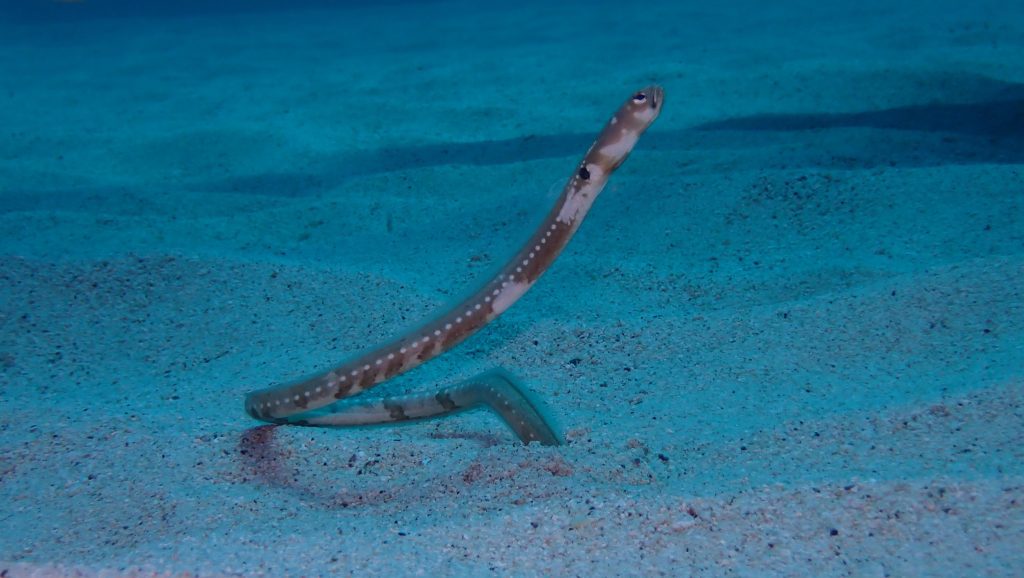
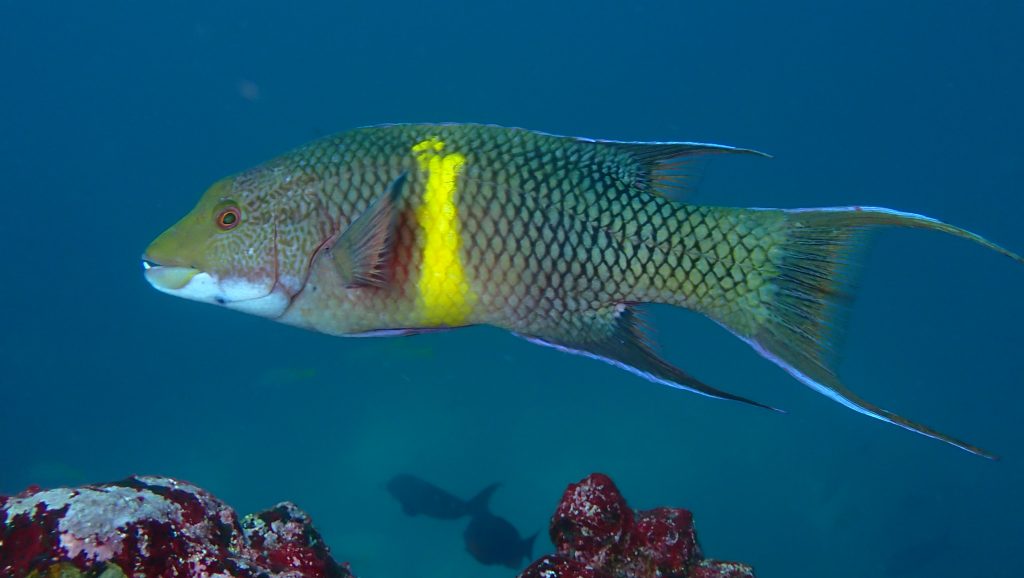
Visibility is greatly affected by the current, the stronger the current the cleaner the water. For your safety, stop holding on to a rock because the water flow speeds up at the top of the shallow part of the reef. what is important to follow the dive guide. The water temperature in this area is a comfortable 23-24C (74-76 F) in the wet season and a cooler 20-23-C-(68-73 F) in the garua season. other marine life seen on this dive includes spotted porcupinefish, balloonfish, bumphead parrotfish, bluechin parrotfish, blunthead triggerfish and fine scale triggerfish, schools of spotted eagle rays are frequently seen cruising over the sand bottom.
Daphne Minor, a tuff cone (giant pile of compressed volcanic ash shaped like a cone), sits off the north coast of Santa Cruz, west of Baltra and North Seymour. The dive site is on the west side of the islet.
Pelagic are infrequent visitors, even when there are strong currents, so the main highlights are the abundance of fish and a drift dive along the impressive drop-off at the top of a sloping wall blue-striped nudibranchs, octopuses, pleurobranchs and slipper lobsters hide in recesses in the wall and along ledges in areas protected from the current. Schools of grunts, tuna, yellowtailed snapper, and surgeonfish flow along the drop-off. Other fish regularly seen here include king angelfish, pufferfish, streamer hogfish, parrotfish, flag cabrilla and wrasse. The currents are persistent, but highly variable.


North Seymour is on the northeast corner of Santa Cruz, north of Baltra and Mosquera, and this dive follows its east coast. The current comes from the east and southeast, bends north and then sweeps around the northeast corner of the island, making this an interesting drift dive.
It is a collapsed wall forming caves inside the ceuvas where whitetip sharks rest, forming very fascinating slopes and we can see how it ends in a sandy bottom, this place you can see big things like hammerhead sharks, large schools of movulas, reef fish, puffers, and cornet fish.
Punta Carrion is located behind Santa Cruz Island, between Baltra Island and Santa Cruz is the Itabaca Channel.
A very quiet place good for diving before diving in an advanced place, topography of sand followed by a wall formation that is not completely vertical, its current is moderate easy diving, you can see starfish, rays, whitetip sharks, usually surprising with big things like molamola and whale sharks
Punta Carrión está ubicada atrás de la isla Santa Cruz, entre la isla Baltra y Santa Cruz está el canal Itabaca.


When the current is present, look for pelagics, including rays and sharks. Be on the lookout for cleaning stations on the reef. Champion has two small colonies of sea lions. Creolefish are scatered on the reef.
The prevailing currents come from the southeast after they wrap around the corner of Floreana and are usually moderate, but occasionally they can be quite strong. Normally, you begin the dive near the northeast corner of the island and let the current carry you along. When current dies down, this can still be a great dive.
Sea lions’ rule. They usually appear right at the beginning of the dive and cavort with divers or lie on the ledges. The terrain at the beginning of the dive is a steep boulder slope than gives way to a vertical wall with terraced ledges. The wall drops to a sloping sandy bottom at 30 m (100ft). There is a considerable amount of black coral on the and walls. Sea turtles are always found resting amidst the coral, almost always in large numbers. There are many undercuts and overhands to explore. Upon close inspection, you may find Pacific seahorse, longnose hawkfish and coral hawkfish among the coral branches. Off the wall, you will encounter big schools of white salema, yellowtail surgeonfish, creolefish and yellowtail grunts. When the current is present, look for pelagics, including rays and sharks.
Gordon Rocks one of the best dive sites in the central islands, is on the northeast side of Santa Cruz not far from south Plaza. It is a partially eroded crater at the top of a tuff cone. Three sections of the jagged edges of the cone are visible above water and tower above the surface of the sea, appearing to be three separate islets. Looking down on the crater from above, the remaining portions of the craters edges roughly form the shape of a U. The top or south end of the U is open to the sea and most of the eastern and western edges of the crater are still intact. On the northwestern side is a second small section of rock, and at the north end, or bottom of the U, three separate submerged pinnacles are separated by narrow channels. The tops of the pinnacles are at 6-8m (20-25ft), while the bottoms of the channels are at depths of 15-18m(50-60ft) near the outer edge of the cone. The channels slope downward toward the inside of the crater, whose center has a fairly flat, sandy bottom at a depth of about 43m (140ft). There is a pinnacle in the middle that juts up to about 18m(60ft).
The outer sides of the crater are steep. Near-vertical in most places, they plummet into deep water diving around the pinnacles is almost always tricky because of the strong current that can blast through the channels, so stay close to the rocks in case you need to hold on when you hit the current. When you cross a channel, swim quickly and hold on when you reach the other side. Manta rays are commonly encountered in this area (usually on the interior side of the pinnacles), especially when water temperatures are warmer. The mantas feed near the surface in 6m(20ft) or less, but are also found a lot deeper. Most activity will be at the four corners of the crater (i.e. near the edges of the huge rocks protruding from the water)

Swim away from the rocks at the end of the dive because the surge is usually very strong in the shallows and it is better to make your safety stop in the blue. When the currents run toward the southwest, schools of hammerheads patrol out away from the submerged ledge at the southwest corner. Diving at Gordon Rocks absolutely requires the use of safety equipment such as flags, safety sausages and air horns.
Have been diving for the last 4 months and have 25 dives.

At the very east end of the platform, monay eels and turtles are often observed in holes and crevices along the edge of the drop-off, just before it turns into a slope of rocks and sand.
The site at the northeast end of Bartolome is an easy dive that is rarely visited by live- aboard and only occasionally by land- based operators from Santa Cruz. A large shelf extends outward from the shore, with a drop-off at the outer edge of the platform that begins at about 18m (60ft). currents normally come from the southeast and wrap around the corner of the island. There are numerous fissures or cut that lead to caves of varying sizes and small dive light is handy to search out moray eels, slipper lobsters, small invertebrates and resting white-tipped reef sharks. Look for blue-striped nudibranchs, octopuses, pleuobranchs and slipperd lobsters in recesses on the wall and long ledges in areas protected from the current. schools of grunts, yellow-tail snapper, and surgeonfish are often seen floating over portions of the reef and hanging in small clusters. Other fish common at Bartolome include king angelfish, puffers, butterflyafish, parrotfish, flag cabrilla and wrasses. There is black coral in some deeper areas along the droop-off, where blennies, hawfish and clinids hide in and around the coral branches. platform where divers often encounter pelagic, especially if there is a current. You can expect to see a variety of large animals including eagle rays, Galapagos sharks, hammerheads, golden cowrays, wahoo, and schools of barracuda.
Many live-aboard dive itineraries begin the first full day in the Galapagos with two morning dives at a small, inhospitable-looking islet named Cousins Rock. A small portion of the outer edge of an old, eroded crater resembling a squat pyramid is all that still protrudes from the water. This small triangular-shaped islet is north of Bartolome, on the east side of Santiago this is an incredible dive for finding macro subjects. Bright orange pacif seahorses (some of which grow to a length of nine inches or more) have their tails wrapped securely around branches of coral, usually in depths of 15-21m(50-70ft).
Occasionally you will find small frogfish on these ledges at depths of 21-27m(70-90ft) or more, and the red and white striped, long-nose hawkfish flit among the black coral branches.
This shallow area is usually teeming with schools of fish, including yello-tailed goatfish, blue-striped snapper, and a variety of grunts. the top of the ridge is home to an assortment of blennies, including the always-amusing large banded blenny, which seems eager to pose for pictures if conditions are calm.

Streamer hogfish and octopus are also plentiful. Sea stars and sea cucumbers are everywhere, and young sea lions are almost always present in the shallows, seemingly eager to tug on fins, gauges and snorkels as you proceed with your dive.